
Two PET sheet quotations can describe the same thickness and clear finish yet leave the most expensive questions unanswered: will the ink stay attached, will the folded edges meet the appearance standard, and will the glue seam hold on the actual bonding surface?
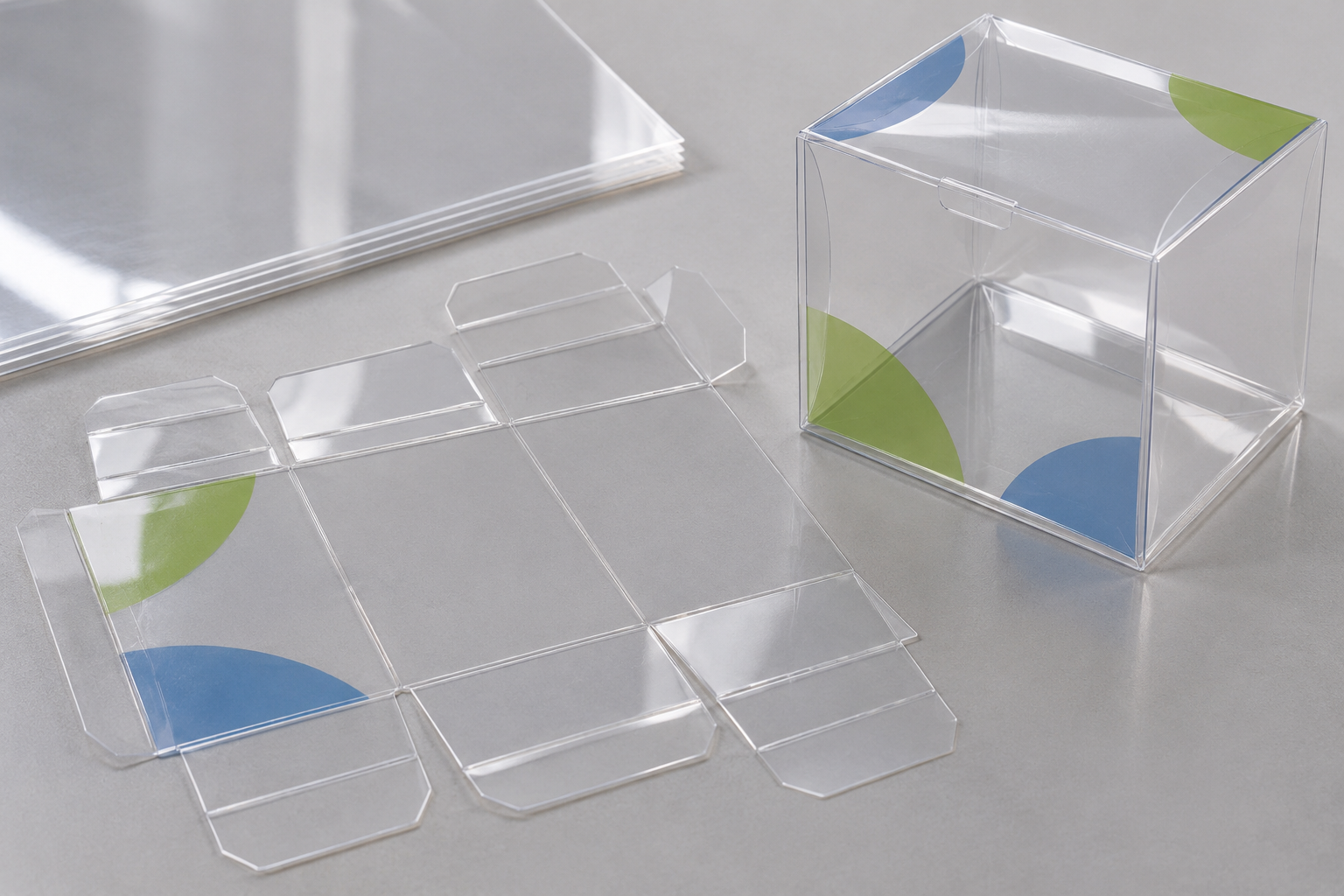
For a printed folding box, a clear flat sample answers only part of the purchasing question. The sheet must suit the complete route from printing through cutting, creasing, folding and bonding. We recommend defining that route before comparing grades or accepting a quotation based on clarity alone.
Start with the box design, print layout and bonding requirements
Send the box drawing or dieline with the inquiry. Identify the display panels, fold lines, printed areas, clear windows and glue flap. Include the packed product’s weight and the stiffness expected from the assembled box. These details give the sheet specification a practical purpose.
The print layout matters because the surface receiving ink may also carry a coating, varnish or adhesive later. Reverse printing creates a different surface arrangement from printing on the outside. A glue flap bonding to bare PET is also a different requirement from one bonding to an ink or varnish layer.
Before requesting PET sheet for printing, establish:
- The printing method, ink system and intended drying or curing route.
- Whether printing is on one side or both sides, including any primer, white ink or overprint coating.
- Which surfaces meet at the seam and the proposed adhesive system.
- Whether artwork crosses a crease and how visible those folded areas will be.
- Whether the converter receives rolls or cut sheets, with the required dimensions and handling format.
An adhesive described as suitable for PET does not automatically establish suitability for every printed or treated PET surface. Give the sheet supplier and ink and adhesive suppliers the same construction details so their recommendations address the same box.
Specify the structure, gauge, appearance and treated side
PUSITE supplies corona-treated print-grade PET / R-PET sheet for printed folding boxes, gifts and display packaging in thicknesses of 0.18–1.7 mm and widths of 250–1400 mm, with custom colour options. Availability should be confirmed for the selected structure, gauge, colour and roll format.
That supply range is not a folding-box thickness recommendation. Select the gauge around panel size, required stiffness, fold design and the converter’s acceptance requirements. Increasing thickness may improve panel rigidity while making the fold and closure more demanding. A thinner sheet may reduce material use but leave a large panel insufficiently supported.
We would put nominal thickness and the agreed tolerance into the inquiry together. Two offers at the same nominal gauge are difficult to compare if their permitted variation differs, particularly when crease appearance and box fit are sensitive to thickness.
Name the construction rather than accepting a broad PET description
Specify whether the proposed material is virgin APET, a PET grade with an agreed recycled-content requirement, or another defined structure. PUSITE also offers GAG sheet with a PETG / APET / PETG three-layer construction for applications including printing. Treat a structure change as a separate material proposal requiring compatibility assessment; the PET family name does not make the surfaces interchangeable.
Where recycled content is requested, define the content requirement alongside colour, haze, visible gels and other appearance limits. Do not assume that a recycled-content change will preserve the approved visual result without comparison.
Define appearance on the finished display area
“High clarity” is too broad for an acceptance specification. Agree which defects matter, where they matter, and how they will be assessed. A gel or scratch in a clear display window can be more objectionable than the same defect hidden beneath opaque artwork.
Use an approved visual reference with agreed viewing conditions. Inspect an assembled printed box as well as the incoming sheet: folds, overlapping panels and printed backgrounds can make defects more noticeable. For repeat orders, consistent colour and appearance across batches deserve more weight than one exceptional sample.
Identify each functional surface
State whether treatment is required on one side or both, how the treated side will be identified, and how it will face in the supplied roll or sheet stack. Include any anti-block treatment or other surface modification in the specification.
A designation such as “corona-treated PET” is incomplete when the print operator cannot reliably identify the intended print face.
Confirm treatment condition, storage history and compatibility
Corona treatment is a specification to confirm, not a guarantee of ink adhesion. It can improve surface wettability, but the final result also depends on surface cleanliness, the ink chemistry, curing and any intervening coating. Bonding introduces a further interface that needs its own assessment.
The useful purchasing question is therefore more precise than “Is it treated?” Ask what surface condition is agreed, on which side, measured by which method and at what point before use.
Connect the treatment requirement to the printing date
A dyne reading indicates wetting behaviour under the chosen test conditions. It does not directly measure the strength of a cured ink film or an adhesive joint. A satisfactory reading cannot replace application testing.
Surface condition can change during storage and handling. Ask for production and treatment dates, recommended storage conditions, packaging requirements and any recommended interval before printing. Keep batch identity through delivery and conversion so an adhesion problem can be traced to the material actually used.
For imported rollstock, the interval between manufacture and printing includes transport and warehouse time. If the purchasing requirement addresses only the condition at dispatch, it may leave the converter’s actual printing date outside the agreed basis. Define where treatment condition will be checked and how material outside the agreed condition will be handled.
We would avoid setting a universal dyne target without the ink supplier’s input. Agree a project requirement and measurement method, then establish whether that condition supports the intended printing system.
Disclose anti-block and other surface treatments
PUSITE offers both silicone-oil-coated and embedded non-silicone anti-block PET options. Their presence needs to be considered alongside printing and bonding requirements rather than treated as an unrelated handling feature.
A release-oriented surface treatment may interfere with wetting or adhesion. An embedded non-silicone option also needs project-specific assessment; its description alone does not establish print compatibility. Identify the treatment on each relevant face and compare the proposed sheet with the actual ink and adhesive systems.
The same principle applies when considering a hard-coated surface for scratch-sensitive display areas. Confirm where the coating sits relative to the print and glue seam. Additional surface functionality is useful only if it remains compatible with the package construction.
Investigate the interface before changing the grade
If printing or bonding fails, record where separation occurs. Ink lifting from PET, adhesive releasing from bare sheet, and a printed layer separating beneath the adhesive point to different interfaces. These observations narrow the investigation; they do not prove a single cause.
Check treated-side identity, storage history, contamination, ink cure and adhesive compatibility before assuming that the base PET grade is unsuitable. Change one material or surface variable at a time where practical. Otherwise, an apparently successful replacement may leave the original cause unresolved.
Set acceptance criteria for printing, creasing and bonding
The purchase specification needs observable acceptance criteria, not simply “suitable for printing and folding.” We recommend agreeing these criteria before samples are approved, so both the quotation and subsequent deliveries refer to the same requirements.
| Area | What to agree | What the assessment needs to establish |
|---|---|---|
| Incoming sheet | Structure, gauge tolerance, dimensions, appearance limits and side identification | Delivered material matches the specified construction and format |
| Surface condition | Required face, agreed wetting test, measurement timing and handling conditions | The surface meets the agreed condition at the relevant stage |
| Printing | Actual ink system, curing conditions, adhesion and rub assessment methods | Printed areas withstand the agreed handling without unacceptable lifting or damage |
| Creasing | Representative fold locations, artwork coverage and visual reference | Folded areas meet agreed limits for whitening, cracking and print disruption |
| Bonding | Actual mating surfaces, adhesive, conditioning period and joint assessment | The seam meets the agreed requirement after the specified conditioning |
| Finished appearance | Assembled box, viewing conditions and defect limits | Display panels, windows and folds meet the approved presentation standard |
Crease whitening and cracking deserve separate descriptions. A visible white line, a split in the sheet and damage limited to the printed layer are different defects. Their possible causes include material construction, gauge variation and the interaction with the converting route. Photographs and retained examples help define what is acceptable without turning the inquiry into an equipment-setting exercise.
For bonding, state whether the seam is assessed after initial assembly or after an agreed conditioning period. Record the failure location as well as the result. A seam that opens because ink separates from PET requires a different discussion from adhesive releasing at a clean, unprinted surface.
Use representative material and the intended construction for approval. A small unprinted coupon cannot establish crease appearance or seam suitability. Once accepted, retain the sheet specification and printed, folded and bonded references together. Require proposed changes to structure, recycled content or surface treatment to be discussed against those requirements.
The purchasing priority is repeatable converting suitability. A lower roll price has limited value if the quoted construction leaves print adhesion, crease appearance or bonding unresolved.
FAQ About PET Sheet for Printed Folding Boxes
Can the same PET sheet be used for different printing methods?
Possibly, but approval should be specific to each printing system. Ink chemistry, curing and surface requirements can differ between methods. Ask the ink supplier to assess the proposed sheet and confirm compatibility before extending an existing approval to another process.
Should the glue flap be left unprinted?
Leaving the glue area unprinted can simplify the bonding interface, provided it suits the box design. If ink or varnish remains in the seam, qualify the adhesive against that complete layer arrangement. Make the intended glue area explicit on the dieline.
Does PET need corona treatment on both sides?
Only when the functions on both sides justify it. Map the print and bonding surfaces first, then agree the treatment required on each face. Two-sided treatment does not remove the need to confirm ink and adhesive compatibility.
Can an approved sample cover a later change in recycled content?
Do not assume it can. A recycled-content change can affect appearance and may alter converting behaviour. Compare the revised material against the agreed sheet, print, crease and bonding criteria before accepting it under the existing specification.
Discuss sheet specifications, samples or a quotation
Share your box drawing, application, proposed material, thickness, width or sheet dimensions, printing system, bonding surfaces, appearance requirements, estimated quantity and destination market with PUSITE. We can discuss suitable sheet options and representative samples or a quotation around those requirements.