
Two quotes for a conductive HIPS roll list the same resistance range. One specifies a conductive coating and the other specifies embedded conductivity. Your tray drawing shows where the component sits, but the electrical requirement says nothing about the pocket wall that guides it in or the underside that rides on a fixture. Those details can change which roll you should sample first.
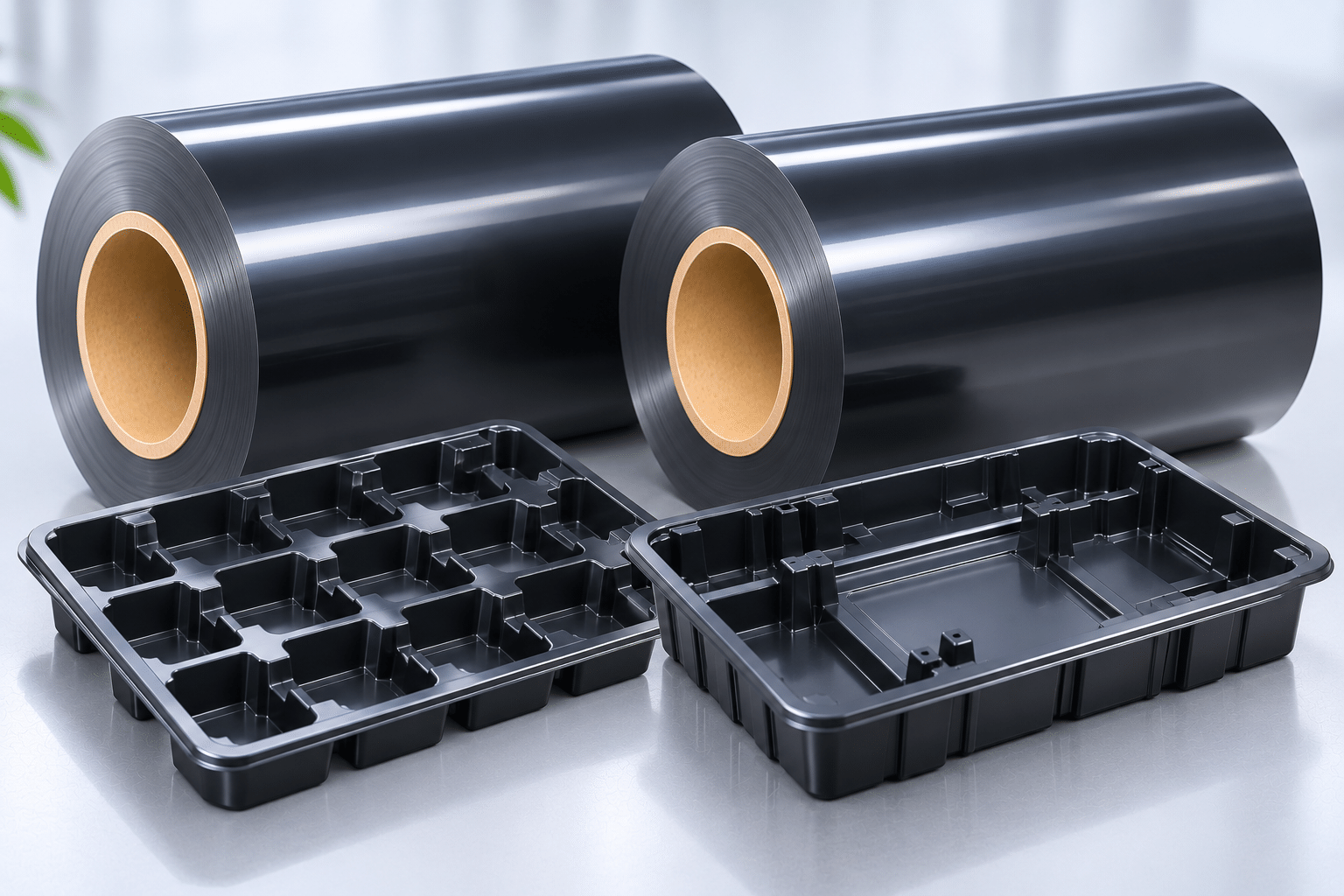
When we compare HIPS rolls for thermoformed electronics packaging, we give the most weight to resistance at the locations that matter on the formed tray. For coated sheet, we also look at whether the coating stays intact where the tray rubs during loading, stacking or reuse.
Map the tray surfaces that matter
Mark the component support points and any walls or ribs the part touches during loading and unloading. Then mark the tray surfaces that contact guides, fixtures and other trays. A component may sit entirely inside a pocket while the tray repeatedly slides along its outside flange. If the fixture is part of the intended electrical path, identify that contact separately from surfaces that only need to withstand rubbing.
For coated conductive HIPS, transfer those marks back to the flat sheet. Label which face must become the pocket interior and which becomes the underside, then specify how the roll should be identified and loaded. If the tray needs electrical performance on both faces, write that into the inquiry before comparing quotes.
Compare where each sheet provides conductivity
PUSITE offers coated conductive HIPS and black embedded conductive HIPS in the roll dimensions below. Confirm availability for the selected construction, gauge, color and roll format.
| Decision factor | Coated conductive HIPS | Embedded conductive HIPS |
|---|---|---|
| Where conductivity is provided | In a coating on the specified sheet face or faces | In the sheet material itself |
| What to verify on the formed tray | Resistance on the required coated faces and coating adhesion and integrity after forming and representative handling | Resistance at the required contact points, including drawn or thinned areas that matter to the application |
| Roll thickness and width | 0.3–1.5 mm thick and 300–900 mm wide | 0.3–1.8 mm thick and 300–900 mm wide |
| Color | Custom color options | Black |
If the electrical requirement is concentrated on a defined face and handling is gentle, we would start with coated HIPS, particularly if the project needs a custom color. If the working surfaces repeatedly slide against guides or nested trays and black is acceptable, we would sample embedded conductive HIPS first. Its conductivity comes from the sheet material, so there is no conductive coating to qualify for wear. The formed tray still needs to meet the resistance requirement at the marked locations.
Agree on what the resistance reading represents
A flat-sheet reading gives you a basis for screening incoming material. A formed-tray reading tells you whether the relevant location meets the part requirement. Keep the two acceptance criteria separate in the specification. A rim can be easy to measure while a deep pocket wall is where the component actually makes contact. Stretching and wall thinning can change the reading across the tray, and a coated surface can also respond differently in heavily drawn areas.
Before ordering trial rolls, agree on the resistance target for each stage, the face to test on flat stock and the exact points to measure on the tray. Mark the rim, wall or deepest cavity where each is relevant, along with any fixture contact included in the electrical requirement. Specify the test method, electrode arrangement, test voltage and conditioning, including temperature, relative humidity and conditioning time. If the electrodes used on flat stock cannot seat properly in a pocket, agree on a setup suited to that geometry and document it with the readings. That gives both sides a way to reproduce a result when a lot is questioned.
Check coating integrity and confirm the roll dimensions
For a coated roll, inspect the marked areas after forming and again after handling that reflects the job. If trays are nested and separated repeatedly, check the surfaces that slide against one another. If a fixture rubs the underside, reproduce that contact. Agree on how to check adhesion and what counts as unacceptable lifting, wear or transfer. Repeat the resistance measurements at the affected locations after handling. Appearance and electrical readings answer different acceptance questions.
Before quoting the selected construction, we would put the nominal starting gauge, tolerance and usable web width in writing. Include the line’s core and maximum roll diameter requirements and, for coated material, identify the required face and winding orientation. Select the starting gauge with the formed pocket in mind, especially where the wall draws thin. Carry the chosen construction, measurement locations and handling criteria from the trial into the purchase specification so repeat orders can be checked on the same basis.
FAQ About Conductive HIPS for Electronics Trays
How should we write the enquiry if both tray faces need electrical performance?
Mark the required locations on both faces of the tray drawing and state the resistance limits for each. If a coated construction is selected, ask whether both faces need treatment and how they will be identified. If the construction is still open, include embedded HIPS as a candidate and judge both options against measurements at the required locations on the formed tray.
What evidence should a supplier provide before we trial a substitute roll?
Ask for the proposed construction, the test method and conditions behind the quoted resistance, and an identified sample from the proposed grade. Record differences from the approved roll in the trial brief so a flat-sheet match is used to screen the sample, not as permission to substitute it.
What should we check at receiving on repeat orders?
Check the lot identification, construction, roll dimensions and, for coated material, face identification and winding orientation. Sample flat-sheet resistance at the agreed frequency and link the readings to the lot. Keep formed-tray and handling checks in the acceptance plan at the frequency agreed for the application.
Share the tray drawing, electrical requirements, expected handling, target gauge and width, roll format and estimated quantity with PUSITE. We can discuss which conductive HIPS roll to sample first or use those details to prepare a quotation.
Related Articles
- Why choose conductive thermoforming HIPS plastic rolls for electronic tray?
- HIPS Plastic Rolls Electronics: Conductive Thermoforming Sheets Redefine Anti‑static Packaging
- Anti-Static HIPS Plastic Rolls – Engineered for Vacuum Forming in Electronics Packaging
- Why choose HIPS plastic rolls for electronic tray?