
Two PET samples can look equally clear and measure the same thickness, yet behave differently when printed, creased and glued into a box. If your inquiry specifies only transparent PET and a gauge, the quotations may describe materially different surfaces.
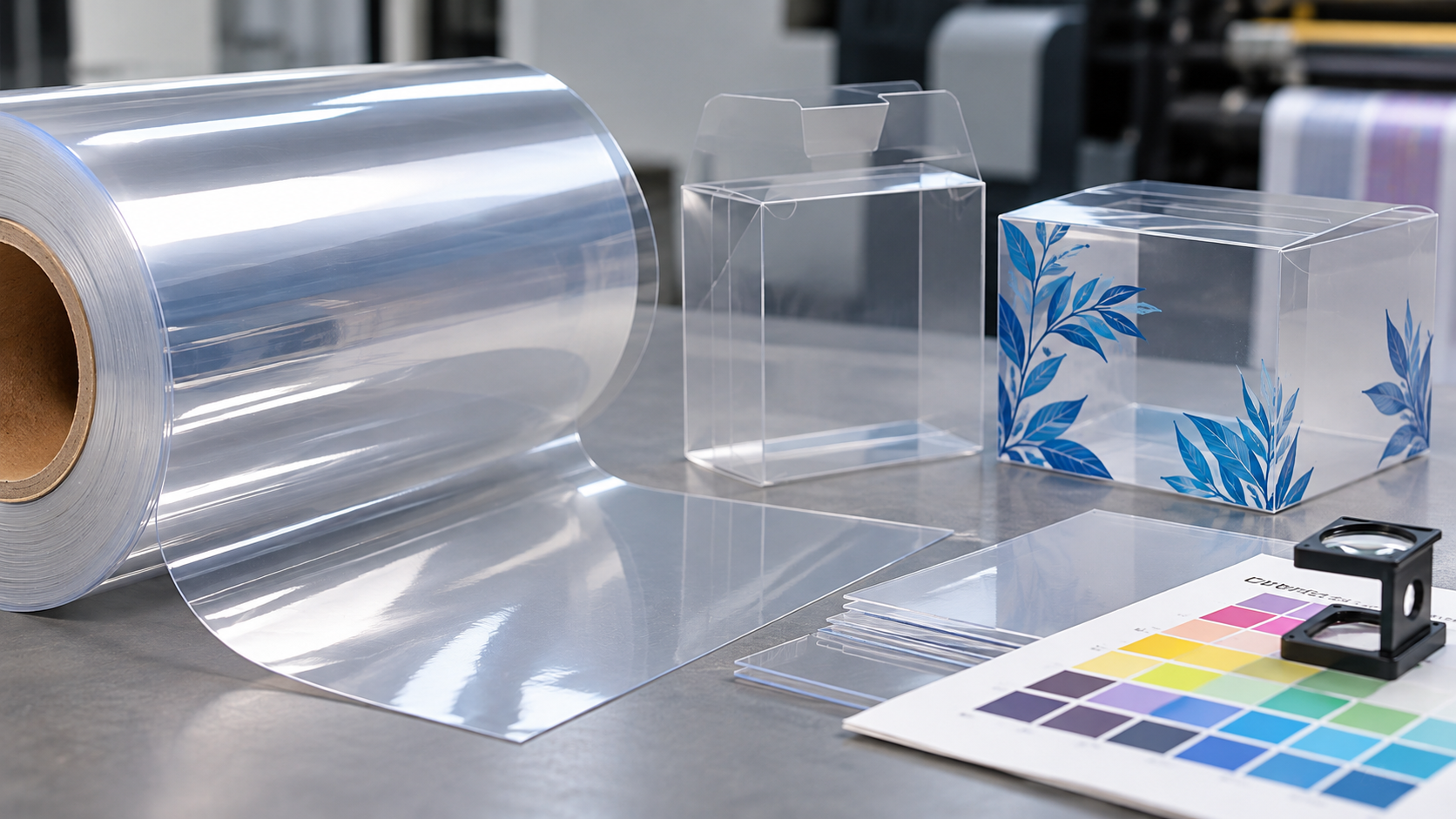
For a printed folding box, approve the sheet around the complete converting route. Surface-treatment compatibility and finished-box appearance deserve more attention than a clear flat sample alone. Corona treatment is a useful specification detail, but it does not establish compatibility with every ink or adhesive.
Start with the box design and the printing and bonding route
Send the box drawing or dieline with the material inquiry. Mark transparent display areas, printed panels, folds and the glue flap. Identify whether printing sits on the outside or is viewed through the sheet, and show which surfaces meet at the bonded joint.
We would put those details ahead of a request for the lowest PET sheet roll price per kg. They determine what the surface must do and whether two offers are genuinely comparable.
The inquiry also needs the printing method, proposed ink system, any primer or varnish, and the adhesive or alternative joining method. If separate companies handle printing and box assembly, agree who will confirm compatibility across both operations. Otherwise, each stage may approve its own result while the assembled package remains unresolved.
Thickness belongs in this discussion, but it cannot be selected from box dimensions alone. Panel stiffness, fold behavior, closure design and handling requirements all affect the choice. Increasing gauge to improve rigidity can also change the creasing requirement; it does not solve a surface adhesion problem.
PUSITE supplies corona-treated print-grade PET and R-PET sheet for printed folding boxes, gifts and display packaging, with thickness options of 0.18–1.7 mm and widths of 250–1400 mm. Availability should be confirmed for the selected structure, gauge, colour and roll format. This supply range is a starting point for specification, rather than a recommended gauge range for every folding box.
Specify the treatment side, surface condition and appearance
“Corona-treated PET” leaves an important question unanswered: which side receives treatment, and how will the converter identify it?
Specify one-side or two-side treatment as required by the design. Connect that requirement to a clear side-identification and winding convention. Printing on one face does not necessarily mean that the glue joint uses only that face; the dieline should establish the actual contact surfaces.
Agree the surface-wetting requirement with the ink and adhesive providers, including the measurement method and the point at which it applies. A value measured before dispatch and one measured when printing begins describe different stages. Include the expected storage interval between delivery and use, because surface condition can change with time and handling.
We would not assign a universal dyne target to every printed box. A dyne measurement helps assess wetting, but it is not a substitute for ink adhesion or bond testing with the selected materials.
Ask about coatings and additives as well. PUSITE offers silicone-oil-coated and embedded anti-block PET options, but neither designation establishes print or bonding suitability. A surface selected to reduce sticking during handling may introduce a different compatibility question downstream. Do not substitute an anti-block grade for an approved print-grade sheet simply because the material and dimensions match.
Appearance needs equally specific language. Agree expectations for tint, haze, gels, specks, scratches and surface marks, distinguishing prominent display panels from concealed areas. Use an approved visual sample and defined viewing conditions rather than relying on “high clarity.” A small defect that is acceptable in an industrial tray may be conspicuous across a clear retail box.
If recycled content is required, state it separately from appearance acceptance. Compare virgin and R-PET options against the same visual standard; neither a material label nor one exceptional sample establishes repeatability.
Examine ink adhesion, creasing and adhesive compatibility together
The decisive question is whether the specified sheet supports the assembled box, not whether it passes three unrelated checks.
A flat printed patch may look satisfactory before the sheet is folded. A glue test on unprinted PET may say little about a joint that actually bonds to varnish or ink. Keep the intended layer sequence and fold locations visible throughout material evaluation.
Confirm what the ink must adhere to
Identify the exact surface receiving the ink: treated PET, a primer or another coating. Record the ink system and any overprint finish, then agree how adhesion and rubbing resistance will be assessed after the specified drying or curing period.
Surface wetting and adhesion are connected, but they are different questions. Ink can appear to spread acceptably without developing the required attachment to the surface. Conversely, a printing defect does not prove that the sheet treatment is the sole cause; contamination, ink selection and curing conditions can also contribute.
Our recommendation is to use the surface measurement as a control point and the printed result as the application decision. Avoid approving a roll solely because a dyne reading meets a number.
Include areas with heavy ink coverage and artwork near folds. These locations can reveal limitations that an isolated logo on a flat sample does not expose.
Separate sheet whitening from ink damage at the crease
A white line at a fold may involve deformation of the PET, cracking of the printed layer, or both. Changing the sheet grade before identifying which layer is affected can send the specification in the wrong direction.
Compare unprinted and printed folds made from the same material. Inspect for sheet whitening, cracking, ink lifting and unacceptable springback. Relate the findings to the selected gauge, sheet structure and intended crease design, without treating one symptom as a definitive material diagnosis.
A stiffer panel is not automatically a better folding-box material. If an increase in thickness improves the display face but produces an unacceptable fold, the specification still needs work. Discuss gauge or grade alternatives against both requirements rather than solving them independently.
Check the actual adhesive interface
Draw the joint as a sequence of layers. Is the adhesive contacting bare PET, treated PET, ink or varnish? Does the artwork leave an unprinted bonding area? These details can matter more than the adhesive’s general description as suitable for plastics.
Confirm compatibility with the adhesive provider for the actual surfaces and expected service conditions. Assess the joint after the agreed setting period and after representative folding, loading and handling. Note where separation occurs: at the PET surface, within a printed layer or elsewhere in the joint. That observation helps narrow the cause; it does not by itself prove that the sheet is defective.
We would favour a clearly defined bonding area where the design permits it. Adding treatment or choosing a more expensive sheet is premature if the joint is failing through an incompatible printed finish.
Use one assembled-box evaluation to connect these decisions. Retain the sheet specification, surface identification, print construction and adhesive details with the approved sample. If any of those changes, assess the affected interfaces again rather than assuming the original approval covers the new combination.
Agree dimensions, roll format, handling and acceptance criteria
Once the surface construction is defined, make the delivery specification precise enough to support repeat orders.
| Specification group | Details to agree | Purchasing purpose |
|---|---|---|
| Material and surface | PET or R-PET requirement, grade, treatment sides, coatings and additives | Prevents substitution based only on polymer name |
| Gauge and dimensions | Nominal thickness, tolerances, width and any cut-sheet dimensions | Makes quotations and incoming measurements comparable |
| Roll format | Core dimensions, maximum outside diameter or weight, winding direction and treated-side orientation | Matches receiving and conversion requirements |
| Appearance | Approved sample, defect limits, viewing conditions and critical display areas | Gives acceptance a practical reference |
| Protection and identification | Packaging, handling instructions, batch identification and side marking | Supports surface protection and traceability |
| Application acceptance | Agreed print, crease and bond assessments | Connects sheet acceptance to the intended box |
Roll supply and cut-sheet supply also need a clear handoff. If rolls will be sheeted before printing, identify who controls cut dimensions, squareness, surface protection and flatness acceptance. Material that arrives undamaged can still acquire scratches or contamination during subsequent handling.
For appearance-sensitive repeat orders, request representative repeat samples or relevant batch quality information. Consistency across deliveries is more useful than selecting the best-looking piece from one sample pack.
Compare quotations only after these requirements align. A lower material price offers little benefit if the quotation excludes the surface construction or appearance standard needed for saleable boxes.
FAQ About PET Sheet for Printed Folding Boxes
Can a PET grade approved for vacuum forming also be used for printed folding boxes?
Possibly, but vacuum-forming suitability does not establish printing, creasing or bonding suitability. Check the grade’s coatings, additives and treatment sides against the box design, then assess the intended printed and bonded construction before approving the substitution.
Should the surface-wetting requirement apply at dispatch or when printing starts?
Define both points if they matter to the purchasing agreement. A dispatch measurement supports shipment control, while a measurement before printing describes the surface presented to the ink. Agree the method, storage conditions and expected interval between the two so the results can be interpreted consistently.
Can protective film be added to prevent scratches?
Discuss protective film as a project option rather than assuming it is suitable. Its application and removal must fit the printing sequence, and any residue or surface change must be considered for ink and adhesive compatibility. Also define how the sheet will be protected after removal.
What should trigger reassessment after a sheet specification is approved?
Changes to material structure, recycled-content requirement, coatings, additives, treatment side, gauge, ink, varnish or adhesive can affect the approved result. Identify the changed feature and reassess the relevant appearance, fold or bond requirement. Keep the revised specification linked to the accepted sample.
Share your box drawing, printing and adhesive route, appearance expectations, required thickness and width, roll format, estimated quantity and destination market with PUSITE to discuss suitable sheet samples or request a quotation.